5th February 2026
Street and Candid Photography. Andy Leslie
The presentation began with Andy speaking about the history and the definition of Street Imagery. It covers social history, the curiosity of people and places. A run through of the legalities of taking pictures of people in public was helpful.
It all started in 1838 when Louis Daguerre took the first documented photo of a human being. It was called Shoeshine boy. This marked a pivotal moment in photographic history.
The types of street work cover candid, history ( a specific event ), mundane things, amusing, themes, shadows, light & grotesque. Photographers will often adapt to a particular style and this can be seen with famous Street Photographers. Andy illustrated these themes by featuring work by 4 well known photographers , showing many images of their techniques and approach.
First up was Vivian Maier (1926 - 2009 ) An American whose work wasn’t discovered and appreciated until after her death. She worked as a Nanny but her legacy of over 156,000 images of people, places and events has lived on. The photos are amazing both for the breadth of the work and for the high quality of the humorous, moving, beautiful, and raw images of all facets of city life in America’s post-war golden age. Currently, Vivian Maier’s body of work is being archived and cataloged for the enjoyment of others and for future generations.
Martin Parr was then spotlighted by Andy. Martin died in 2025 aged 73. He was a satirical observer of life in the UK. His socially aware photography was groundbreaking and original . Martin originally produced entirely Monochrome work but that all changed in 1982 when he switched to colour imagery. Parr’s work often used a bright, almost artificial-looking colour palette, capturing the humour, irony, and absurdity in everyday life. The Martin Parr Foundation was established in 2017 in Bristol to house his own archive and a collection of British/Irish photography. His major projects were rural communities (1975–1982), The Last Resort (1983–1985), The Cost of Living (1987–1989), Small World (1987–1994) and Common Sense (1995–1999). He has over 100 published books .
Brandon Stanton was next up . Born in 1984, an American author and Photographer. He is the author of Humans of New York, a photoblog and book. Since 2010, Stanton has taken hundreds of portraits of people living and working primarily in New York City, accompanied by bits of conversations about their lives. In 2020, Stanton released Humans, a book of portraits and stories from forty countries around the world. He tells the stories behind the images which bring them to life even more. His style can be described as documenting in still form with a conscience .
Finally Photographer Diane Arbus was discussed. Her specialism was bleak and grotesque. She befriended her subjects but did them no favours . Her controversial images evoked powerful negative reactions. Arbus committed suicide in 1971, but her work has continued to influence photographers for decades.
It is certainly worth looking up these photographers up on the internet !
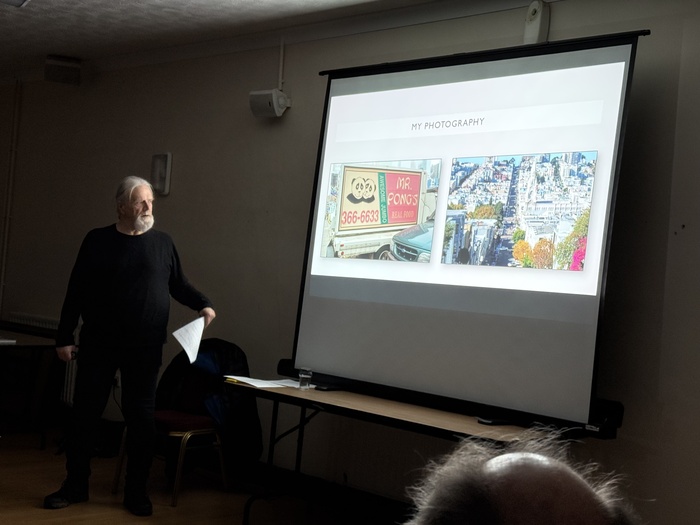
After a break Andy then showed us his style of Street Photography . Working through themes , small panels of photos were shown , including interesting people, street murals and posters, funny signs, transportation, shopping, mobile phones , lunchtimes, family outings and much more . It was good to see many different emotions visualised, expressions to make you smile . Andy emphasised it is easy to have a go at this genre without having to invest in special equipment . A mobile phone is a great beginning .
Andy was warmly thanked for this first presentation from him although he is a regular visitor as an experienced WPF judge for us.
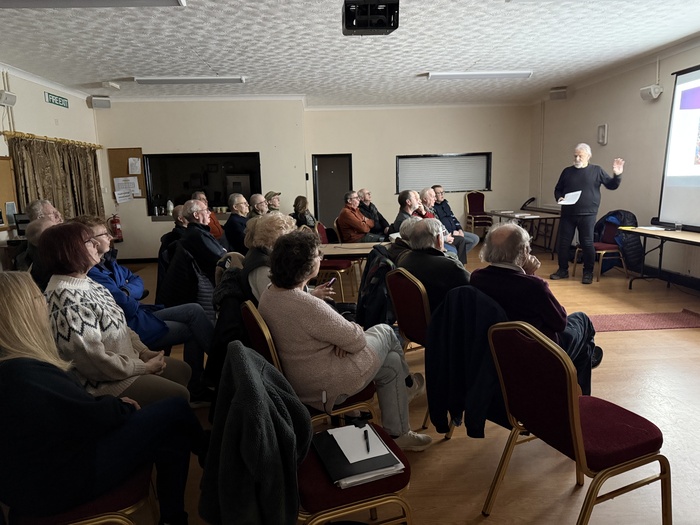
There was a good attendance of around 26 people so this talk was well supported .
Thanks also to Dave Bolton for the booking, Alistair Mackay, Rob Cox as projectionists, Jo Wakeman and Melanie Felton for serving the teas and Colin Potter for reception duties. Also a great team clearing up !
The presentation began with Andy speaking about the history and the definition of Street Imagery. It covers social history, the curiosity of people and places. A run through of the legalities of taking pictures of people in public was helpful.
It all started in 1838 when Louis Daguerre took the first documented photo of a human being. It was called Shoeshine boy. This marked a pivotal moment in photographic history.
The types of street work cover candid, history ( a specific event ), mundane things, amusing, themes, shadows, light & grotesque. Photographers will often adapt to a particular style and this can be seen with famous Street Photographers. Andy illustrated these themes by featuring work by 4 well known photographers , showing many images of their techniques and approach.
First up was Vivian Maier (1926 - 2009 ) An American whose work wasn’t discovered and appreciated until after her death. She worked as a Nanny but her legacy of over 156,000 images of people, places and events has lived on. The photos are amazing both for the breadth of the work and for the high quality of the humorous, moving, beautiful, and raw images of all facets of city life in America’s post-war golden age. Currently, Vivian Maier’s body of work is being archived and cataloged for the enjoyment of others and for future generations.
Martin Parr was then spotlighted by Andy. Martin died in 2025 aged 73. He was a satirical observer of life in the UK. His socially aware photography was groundbreaking and original . Martin originally produced entirely Monochrome work but that all changed in 1982 when he switched to colour imagery. Parr’s work often used a bright, almost artificial-looking colour palette, capturing the humour, irony, and absurdity in everyday life. The Martin Parr Foundation was established in 2017 in Bristol to house his own archive and a collection of British/Irish photography. His major projects were rural communities (1975–1982), The Last Resort (1983–1985), The Cost of Living (1987–1989), Small World (1987–1994) and Common Sense (1995–1999). He has over 100 published books .
Brandon Stanton was next up . Born in 1984, an American author and Photographer. He is the author of Humans of New York, a photoblog and book. Since 2010, Stanton has taken hundreds of portraits of people living and working primarily in New York City, accompanied by bits of conversations about their lives. In 2020, Stanton released Humans, a book of portraits and stories from forty countries around the world. He tells the stories behind the images which bring them to life even more. His style can be described as documenting in still form with a conscience .
Finally Photographer Diane Arbus was discussed. Her specialism was bleak and grotesque. She befriended her subjects but did them no favours . Her controversial images evoked powerful negative reactions. Arbus committed suicide in 1971, but her work has continued to influence photographers for decades.
It is certainly worth looking up these photographers up on the internet !
After a break Andy then showed us his style of Street Photography . Working through themes , small panels of photos were shown , including interesting people, street murals and posters, funny signs, transportation, shopping, mobile phones , lunchtimes, family outings and much more . It was good to see many different emotions visualised, expressions to make you smile . Andy emphasised it is easy to have a go at this genre without having to invest in special equipment . A mobile phone is a great beginning .
Andy was warmly thanked for this first presentation from him although he is a regular visitor as an experienced WPF judge for us.
There was a good attendance of around 26 people so this talk was well supported .
Thanks also to Dave Bolton for the booking, Alistair Mackay, Rob Cox as projectionists, Jo Wakeman and Melanie Felton for serving the teas and Colin Potter for reception duties. Also a great team clearing up !